RESISTANCE & OXYGEN
Do altitude training masks work? What the evidence shows
Do altitude training masks work? In a 6-week trial of 24 adults, VO2max rose about as much without the mask. Masks add breathing resistance but leave the oxygen fraction of the air unchanged. A hypoxic generator changes the air itself.
This page is for general information only and is not medical advice. Talk to a physician before starting any breathing or low-oxygen training.
Do altitude training masks work
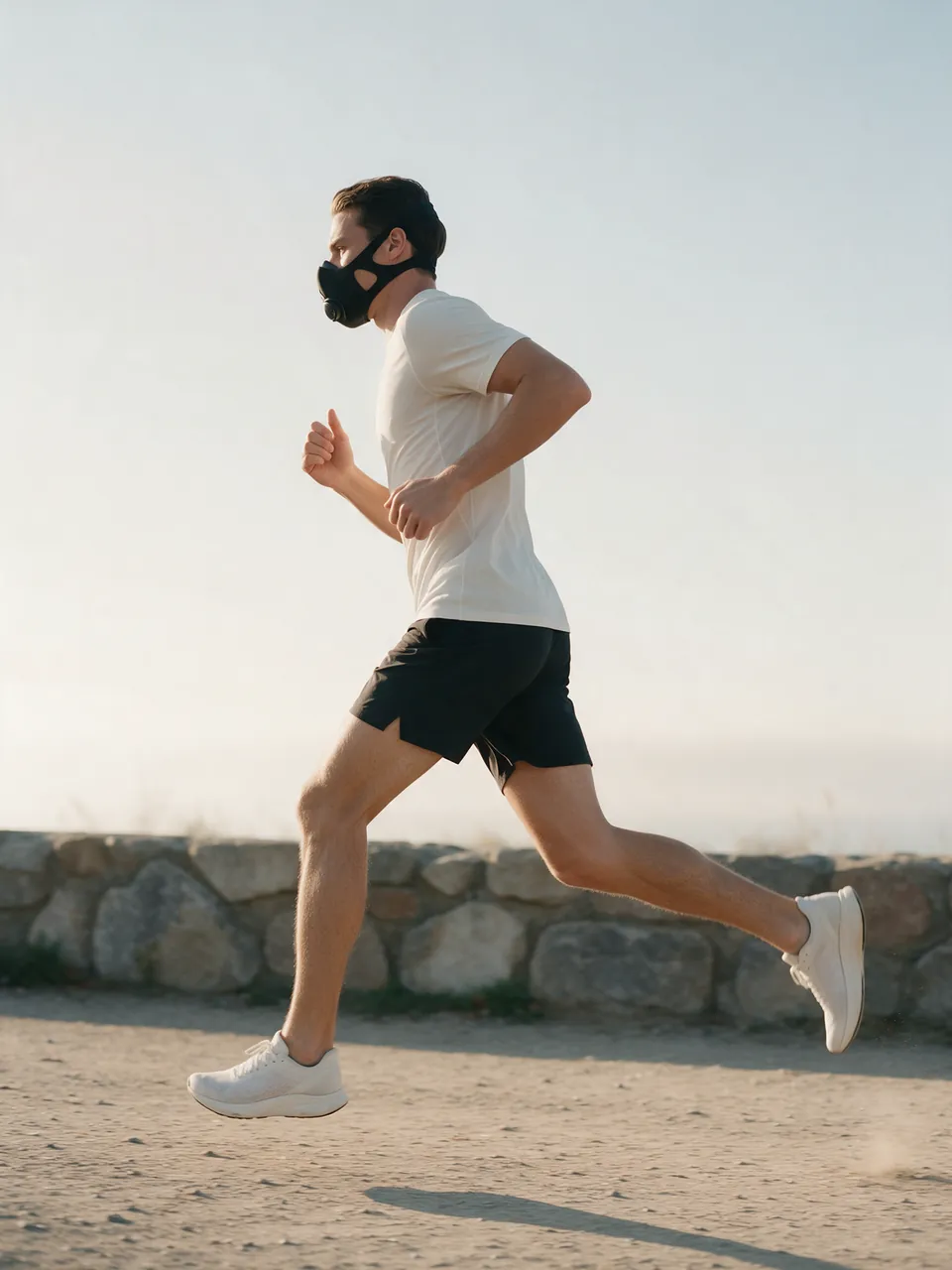
Altitude training masks are breathing-resistance devices, not altitude simulators: in a controlled trial they improved breathing markers but did not change hemoglobin, hematocrit or lung function. The short answer is that altitude training masks work on your breathing muscles, not on your blood. Here is what the data separates.
- What changed: the mask group in one randomized trial improved ventilatory threshold and respiratory compensation threshold markers within its own group.
- What did not change: VO2max gains did not differ from the control group, and hemoglobin and hematocrit stayed the same.
- What the mask actually does: it adds airflow resistance, so the work of breathing goes up while the air stays the same.
If the goal is more red blood cells, then a resistance mask does not supply the low-oxygen air that drives it.
How a training mask restricts airflow
A training mask is a breathing-resistance device: valves and caps make the breathing muscles work harder while the air stays at room oxygen levels. Adjustable openings and flux valves are marketed as simulating 914 to 5,486 m, yet to simulate altitude a mask would need to lower the partial pressure of oxygen. It does not.
A device sold as a hypoxic training mask restricts airflow, not oxygen. Real altitude air still contains about 20.9% oxygen at lower pressure, and generator systems keep normal pressure but reduce oxygen content. In studies, blood oxygen fell a few points during exercise with the mask while breathing volume also fell.
Side by side
| Feature | Resistance training mask | Hypoxic generator | IHHT system |
|---|---|---|---|
| Mechanism | Valves and caps add airflow resistance | Draws room air and lowers its oxygen percentage | Alternates low-oxygen and oxygen-enriched air at rest |
| Air source | Room air, unchanged oxygen fraction | Room air, reduced oxygen content | Reduced-oxygen and oxygen-enriched air through a mask |
| Altitude terminology | Settings marketed as 914 to 5,486 m | Altitude-to-oxygen chart, e.g. 15.4% at 8,000 ft | Inspired oxygen 0.10 to 0.12 hypoxic, 0.30 to 0.40 hyperoxic |
| Setup | Wear during exercise | Generator plus tent or mask, no tanks | Seated or reclining at rest through a mask |
| Relationship to IHHT | None, different mechanism | Supplies low-oxygen air | The IHHT method itself |
What controlled studies of elevation masks found
Controlled studies of elevation masks found similar VO2max gains with and without the mask, small drops in blood oxygen during hard exercise, and higher perceived effort. The pattern is consistent across designs, and the mask did not change repetitions or total workload in resistance training.
| Study | Design and people | What changed | What did not |
|---|---|---|---|
| Porcari 2016 | Randomized, 24 moderately trained adults, 6 weeks of cycling | Ventilatory threshold markers within the mask group | VO2max versus control, hemoglobin, hematocrit, lung function |
| Granados 2016 | Randomized crossover, 10 men walking and running | Ventilation fell about 20 L/min, breathing rate about 10 breaths/min | VO2 between conditions |
| Jung 2019 | Crossover, 15 healthy adults, 40 minutes cycling | Lower SpO2 at 70% VO2peak, higher heart rate, slower heart-rate recovery | Single-session effects only |
| Biggs 2017 | Randomized, 17 people, 6 weeks of HIIT running | Nothing significant between groups | Predicted VO2max and lung volumes |
| Jagim 2018 | Randomized crossover, 20 male recreational weight lifters | Lower peak bar and sprint velocity, lower alertness | Repetitions and total workload |
Limits matter here: samples ran from 10 to 24 people, durations were short, and most participants were young healthy adults.
Respiratory muscle training and where masks fit
Respiratory muscle training means breathing against a load, which is what a resistance mask adds, and meta-analyses of this training report endurance gains in healthy people. Less fit people gained more, about 6.0% per 10 mL/kg/min lower VO2max. In athletes, a review of 21 studies found positive effects on time trials and endurance time.
The mask group in the randomized trial did not improve maximal inspiratory pressure, so in that trial the mask did not act like a dedicated inspiratory trainer. When breathing muscles are the target, then a dedicated, measurable resistance trainer is the tool studied in meta-analyses.
How a hypoxic generator and IHHT change the air
A hypoxic generator is a machine that lowers the oxygen percentage of room air and sends it to a mask or tent, and IHHT alternates that air with oxygen-enriched air at rest. A generator draws room air, lowers its oxygen percentage and delivers it through tubing with no tanks. Published generators start at $1,940, $4,595 and $6,925.
| Simulated altitude | Oxygen percentage |
|---|---|
| Sea level | 20.9% |
| 8,000 ft | 15.4% |
| 10,000 ft | 14.3% |
| 12,000 ft | 13.2% |
| 15,000 ft | 11.8% |
IHHT studies used 4 to 8 cycles at inspired oxygen 0.10 to 0.12 hypoxic and 0.30 to 0.40 hyperoxic, 2 to 6 minutes and 1 to 4 minutes per period, 3 to 5 sessions a week over 3 to 6 weeks. The optimal dose is unknown, and there is no strong evidence that hyperoxic recovery beats normal-air recovery. Studies were supervised with SpO2 monitoring. Our system runs sessions seated or reclining at rest through a mask. See how IHHT sessions work and the IHHT machine.
Mask and generator prices from published sources
Resistance masks cost about $40 to $60 at published prices, while personal hypoxic generators start around $1,940 and an IHHT system costs more. At one retailer, a generator-and-mask package was listed at $2,599.
| Option | Published price | Changes oxygen? |
|---|---|---|
| Resistance mask | $40 to $60 | No |
| Generator | $1,940, $4,595 or $6,925 starting | Yes |
| Generator plus mask package | $2,599 | Yes |
| 1-month mask rental package | $600 | Yes |
| IHHT system | $14,900 with four masks | Yes |
For a fuller breakdown, see altitude training equipment cost.
Safety and who each option suits
Safety depends on the tool: masks raise effort and can cause lightheadedness or anxiety, while low-oxygen air needs screening, SpO2 monitoring and, in studies, supervision. Three participants reported lightheadedness, anxiety and discomfort with the mask.
- A resistance mask may suit someone who wants extra breathing load during training and accepts lower training speed. It is not useful for altitude acclimatization.
- A hypoxic generator or IHHT suits people who want controlled low-oxygen exposure, after physician screening.
If you have a heart or lung condition, then talk to a physician before using either tool. Guideline contraindications include a heart attack within 3 months, unstable angina, a stroke within 6 months, acute infection or fever, polycythemia, thrombosis and individual intolerance to low oxygen. Read more on for home use and our science page.
Frequently asked questions
Do altitude training masks work for hiking at high altitude?
No. A mask does not produce altitude acclimatization, because it does not lower the oxygen you inhale and does not raise hemoglobin. If you are preparing for a high hike, then a tool that lowers the oxygen percentage of the air is the relevant one.
Is it good to wear a mask while running?
It lowers ventilation, drops SpO2 a few points and raises perceived effort and anxiety. In one trial, SpO2 averaged 94%, 91% and 89% across sham, 9,000 ft and 15,000 ft settings. If you need speed or focus in a session, then the mask works against you.
Do elevation masks improve cardio?
VO2max rose about as much without the mask in two controlled trials. The mask group gained 16.5% versus 13.5% in the control group, with no difference in the size of improvement between groups. So the cardio gain came from the training, not the mask.
How can you mimic altitude training at sea level?
Breathe air with less oxygen from a hypoxic generator through a mask or tent, and IHHT alternates that with oxygen-enriched air. A generator keeps normal pressure but reduces oxygen content. Sessions in studies were supervised with SpO2 monitoring.
Is there a best altitude training mask?
There is no ranking here. Check whether a device changes airflow or the oxygen fraction, because only the second lowers the oxygen you inhale. Resistance masks cost about $40 to $60.
Is a hypoxic training mask the same as a hypoxic generator?
No. Only a generator lowers the oxygen percentage of supplied air. A mask sold as hypoxic restricts airflow, not oxygen. If the goal is low-oxygen exposure, then the generator is the tool that delivers it.
Are altitude training masks safe?
Some users report lightheadedness, anxiety and discomfort. People with heart or lung conditions should ask a physician before use. Low-oxygen air also needs screening and SpO2 monitoring, as in supervised studies.
Last reviewed: November 2026
Last reviewed November 2026.
SUPERHUMAN ALTITUDE
Meet the system.
Explore the product, the experience, and the next step.
$14,900 USD
Explore Altitude